Scrum in your daily life

At the AgileCoachCamp (#ACCDE12) I attended a wonderful session named „Scrum in your daily life“.

Deborah W. (#weberde) brought this session up and chose an outdoor location.

We started with six participants and the idea was to share stories, where one had applied Scrum or other agile elements in her or his personal life.

Deborah started and shared how she and her boyfriend used Scrum one weekend to finish her household chores. Next was Sebastian (#stdout); if I remember correctly; who told a story, where a couple organized their flat moving with Kanban.

Quite a few people used retrospective elements with their partner on a time boxed approach (every week 2 hours) and also tried out coaching elements with their kids.

This lead to the question, why do we as coaches have to “fix” the things, which went wrong way earlier in the society. (Well, “wrong” in our opinion).

In the meantime a little crowd of bypassers had gathered to listen and sharing their input.

The topic brought up some stories of regular school life in Germany and Austria and how kids are natural agilists and how that is (seemingly) changed when they enter the school system.

The session was closed after 90 minutes (triple the initial planned time), since it was clear, we could spent even longer on that topic.

On the open space evening news Deborah and Wolfgang (#wwiedenroth) proposed a follow up session the next day.

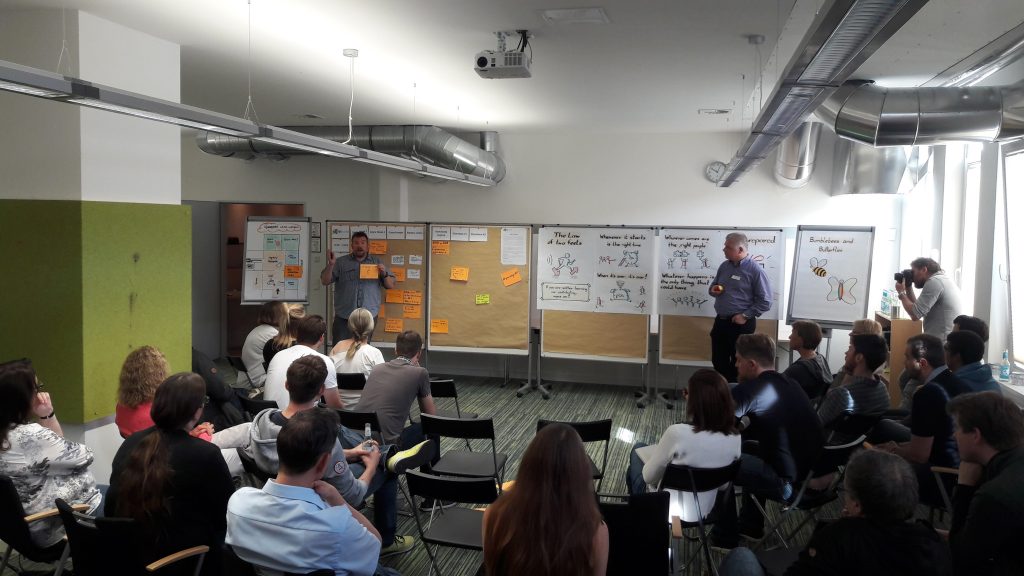
The session was filled with up to 20 attendees. One local school teacher was convinced to join us and shed some of his opinions.

Due to the sheer number of active people we had to use the fish bowl format.

It was a wonderful experience to attend these two sessions and the energy and involvement the people put into it.

I put up some pictures from the second session (agile school theme) here.

(As a side effect, I started to use a personal Kanban board. Let’s see what my retrospective about it will be.)

AgileCoachCamp 2012 (DE)

Last weekend was the AgileCoachCamp 2012 (#accde12) in Rückersbach, Germany.

I got lucky and my spot on the waiting list came through. Willingness to share a double room with a stranger surely helped.

The seminar place was marvelous. It had more than half a dozen rooms for sessions and also two forum sized rooms for group meetings and big sessions. Food was awesome and the service very good. A very good spot for a retreat.

There were some socializing on the arrival day and my roommate turned out to be Michael Leber; who I met at the CAT trainer course.

We watched Germany win their game, nearly doomed by a projector shutting down.

“How many coaches & consultants do you need to abort the 90 second sequence?”.
Well, 40 were not enough. Thanks to the service personnel for helping us out.

Next morning we met at the forum room and we surely needed that space. Seventy people sitting in a circle was quite a sight. The opening session was facilitated and the organizers, sponsors and the Open Space format was introduced.

I had experience on a small scale with this format, but to see it working with so many people was cool.

And here came the typical problem… too many interesting sessions at the same time.

The day went by and I had some good sessions. Some planned ones I skipped and some chance ones I attended. And it was alright as it was.

We got some evening activities like Swing dancing and “Jazz & Agile” and some pretty good games; Pirate Fluxx the secret winner. It was so well sought after, that, even after patiently waiting, I didn’t manage to score a seat in the rounds. I surely have to try that one out.

Sunday was another great day. By now I knew quite some people and we used the breaks or the walking around for chitchat and some good discussions.

Leaving in the afternoon felt quite strange. Happyness mixed with sorrow.
For me it was a very worthwhile spent weekend.

I will blog about two sessions in particular:

1. Scrum in your daily life

2. Two Pronged Approach to Agile Transition.

PotsLightning Announcement for 2012

We are happy to announce another great community event for Agilistos (agile interested persons).

In November are the Agile Testing Days in Potsdam, Germany and it has become an ever increasing stream of participants, which is fabulous in itself.

For those interested for discussions not covered by the conference and with the opportunity not to be limited by a time-boxed session, we coined „PotsLightning“.

It is a Low-Budget, Non-Profit, Free-Entry peer event.

What does that mean?
Most conferences or workshops have entry fees, which often is out of budget for regular folks. Getting your employer to pay for it is also often difficult.

Secondly the tracks are pre-defined by the organizer and might or might not cover your interest.

We decided to organize an alternative form.

There will be no entry fees in any form. Each participant will cover their own expenses, be it accommodation, travel or meals.

We as the organizers will take care of the room, soft drinks (or the odd tray of German beer ;-) ).
So far we always found a sponsor for the room; which most often is the biggest cost.

We also draft a rough vision, what we think could be the topic for the workshop.
Experience shows, that this focal point helps some people to create ideas for their contribution.

And that is another major difference: Each participant is expected to contribute.
Be it in a talk, a presentation, a puzzle, test or code challenge or any other interesting work.

That way we try to ensure, that the workshop will be active and interesting.
It is “by the people for the people” (borrowed from Abe).

So here it is:

PotsLightning (Pre-ATD workshop)
18th of November, 2012
Dorint Hotel (venue of ATD)
Potsdam, Germany

Theme:

  • The role of the tester in agile;
    or why do testers have their own conference
    and do not go to general agile conferences
  • Training and coaching
  • Transition to agile -
    approaches, obstacles, practical experiences?
  • Agile pitfalls, common reason for “failures”;
    lessons learned, etc.

Deadline for contributions: 30th June 2012

You will find more detailed information on the GATE homepage over the course of the next months.

Feel free to contact us if you are unsure. We will be most glad to provide you feedback.

Comments:
The GATE workshop started in 2011 by Markus Gärtner and Maik Nogens.
The second GATE workshop will be held in Munich this September.

While I am the “main face” for the PotsLightning, the initial idea bouncing was with some passionate Agilistos:

Seeing the DEWT and GATE people work together gives me some great ideas for the future. :-)
Who knows, next time we pair with the Danish (DWET) and Swedish (SWT) folks…

GATE auf Reisen, München Ahoi!

Schwer zu glauben, das der erste GATE Workshop (German Agile Testing and Exloratory) schon über ein halbes Jahr zurück liegt…

Im Oktober 2011 starteten wir unsere Vision, einen Ableger einer Community Veranstaltung zu schaffen, welche es weltweit gibt und auch in Europa in einigen Ländern erfolgreich gestartet ist.

Unsere Vision einer Low Budget, Non-Profit Veranstaltung ohne Eintritt haben wir umgesetzt und sind gut gestartet (betrachtet man die damals kurze Vorwarnzeit für Interessierte :-) ); mit Eusebiu Blindu hatten wir internationale Beteiligung und insgesamt sehr viel Spass.

Wir hatten im Kern die Diskussion/Fragestellung, was macht einen “Agilen Tester” aus und ich für meinen Teil habe noch viel Neues mitgenommen an Wissen.

Und endlich haben wir, dank Markus Gärtners Initiative, den zweiten GATE Workshop am Start. Er findet am 08. September 2012 in München statt.

Diesmal geht es um das Thema “Die Zukunft des Agilen und Explorativen Testen”

Wie immer erwarten wir von den Teilnehmern, das sie Beiträge zu diesem Thema einreichen.
Wir sind interessant an

  • innovativen Ansätzen im Testen
  • Kombinationen von Session- und Thread- Basierten Testmanagement
  • Kollaborative Wege zur Test Charta Erstellung
  • Testpraxis (Testing Dojos, Testautomation Codeklausur, Hands-on)

 
Einsendeschluss ist der 1. August 2012, schickt es bitte via EMail.

Genaueres findet ihr auf der GATE Seite.

Bei Fragen, Wünschen oder Feedback findet ihr Markus und mich auch online. :-)

GATE 02 Announcement – German Agile Testing and Exloratory Workshop

We are proud to announce the call for contributions for the second GATE workshop. It will be held in Munich, Germany on September 8th 2012.

The main theme for the second workshop will be

The future of Agile and Exploratory Testing

We expect participants to submit content in line with this theme. We are interested in contributions such as

  • innovative approaches to testing
  • combining session- and thread-based test management
  • collaborative test chartering
  • testing in practice (Testing Dojos, Testautomation Coderetreat, Hands-on testing)

Feel free to contact us if you are unsure. We will be most glad to provide you feedback.

The language of the workshop will be dependent on the workshop participants. It might be German all day, but if we got international contribution, we might decide to hold the workshop in English.

If you want to attend the second German Agile Testing and Exploratory Workshop, come up with a contribution, and send it to us until August 1st. Further details on the attendees, the program, and travel information will be provided later.

If you are interested in the format, there have been quite a few of these peer workshops in the testing space recently. Here are some pointers:

Swedish Workshop on Exploratory Testing
Dutch Exploratory Workshop on Testing
London Exploratory Workshop in Testing
Calgary Perspectives On Software Testing
Los Altos Workshop on Software Testing

Hope to meet you in September 2012.

Blogging again..

What happened in the last year since I last wrote on this blog?

Well, I was in a stage of being unhappy in my last job and that also distracted me from many other things.
Now I a few months into my new job and found the inner peace again to write some blog posts.

I joined a consultancy which has a good setup for agile testing.

This brings along some new aspects for me.

First is being a Consultant.
I did not have that field in my focus, but some peers recommended it to me, so I pondered about it.
The biggest reason to leave the old work was the feeling, that I couldn’t bring the improvements I wanted to bring for the company.
Well, I still believe the improvements would have benefitted the company and that I was not biased and wanted to bring my ideas for the sake of them being mine.

This has been rubbing off on me for quite some time.. Winter 2010 roughly.

The consultant job might help me with that factor. At least I can leave the client, when the project is over and he hasn’t listened to my advice. :-)
I hope it plays out in practice as well as in theory. :-)

Currently I am in a “traditional” project; assisting the test management in a migration from Hosts to SAP IS-U environment.
Very cool. First I learn SAP, second I learn working in a “big” company (coming from middle size firm is a *huge* difference) and third, my help and expertise is really acknowledged and sought after.
That’s a double cool and feels *really* nice.

Second aspect is shaping and sharpening the agile setup of our company.
I work on defining workshop formats and content, on long term new business areas, marketing material and what now.
Since I was always a “Jack-of-all-Trades”, this is also a big benefit for me.
Plus it challenges me also in a good way to think up content and ideas.

Third: I have tester collegues!!!
How cool is that? Working for 3+ years as the Army of One was more exhausting than I recognized before.
Even with the now and then Weekend Testing exchange or user group meetings, I rarely had the chance to discuss testing stuff and bounce ideas.
Or get corrected, when I forgot an important factor in my approach. So YAY for tester buddies.

Fourth I meet so many interesting people.
I did some workshops and testing dojos in a medical device company. Quite some stuff they have and do there.
I also met global testers in the trainings I attended (did I tell already, that my company is big on education their employees..) and got a lot of exposures to different industries, approaches and live experiences from them.

So yeah, 2012 started well. And I hope the Mayans were wrong, otherwise it would *really* suck.

To keep my promise I made (when I find a good job..) I got myself a tribal Ganapathi.
So I also found a new tattoo artist, which I might consult again. :-)

Thanks for reading along,
Maik

German Agile Testing and Exloratory (GATE) Workshop

Ab gestern ist es offiziell:

Markus Gärtner und ich organisieren den ersten deutschen Workshop zum Agilen und Explorativen Testen am ersten Oktoberwochenende 2011 (01 – 02.10.2011).
Der Workshop wird unter dem Namen “GATE – German Agile Testing and Exloratory Workshop” veranstaltet und findet erstmalig in Hamburg, Deutschland statt.
Ab heute können Einsendungen für Beiträge und Themen eingereicht werden.

GATE ist eine Low Budget, Non-Profit Veranstaltung und kostet keinen Eintritt.
Zudem versuchen wir die Kosten niedrig zu halten und wollen auch keinen Gewinn machen.

Für die Teilnehmer bedeutet das eine Kostenbeteiligung nur an den wirklichen Kosten (Raum, Projektor, Strom, Pausengetränke, etc.).
Die sonstigen Kosten (Unterkunft, Anreise, Verpflegung) tragen die Teilnehmer selber.

Momentan rechnen wir mit deutlich unter 100,- EURO pro Teilnehmer.

GATE soll eine gleichberechtigte Plattform zum Erfahrungsaustausch sein.
Ambitionierte Tester, welche praktische Ansätze und Konzepte aus der Zunft des Software Testen lernen und sich austauschen möchten, finden hier gleichermassen Interessierte.

GATE will einen Kontrast zu traditionellen Konferenz-Formaten bieten und und eine Veranstaltung sein, die einen gleichberechtigten Raum für Tester ermöglicht.

Kontroverse Diskussionen, Erfahrungen aus der Praxis, rund ums Thema Software Test. Und das als Low Budget angelegt ist, um möglichst vielen die Gelegenheit zu bieten, teilzunehmen.

Eine feste und wichtige Komponente des Workshop ist die Beteiligung der Teilnehmer.
Wir erwarten von jedem Interessierten, das er oder sie ein Thema oder einen Beitrag einreicht und den auf dem Workshop präsentiert oder darstellt.

Als Gedankenanregung kann folgender Ideenblock dienen:

  • Reale Erfarhungsberichte
  • Kontroverse Testing Techniken oder Methoden
  • Testing Übungen, Praxis (z.B.: Testing Dojos, Hands-on testing)
  • Varianten zum Verteilten Testen

Das ist keine exklusive Liste und wir stehen für Rückfragen, Diskussionen und weiteren Ideen offen zur Verfügung.

Die Sprache des Workshops ist abhängig von den angereisten Teilnehmern.
Bei internationaler Beteiligung wird der Workshop in ENGLISCH abgehalten. Es kann aber auch genausogut Deutsch sein.

Dies sollte ggf. auch bei den Beiträgen berücksichtigt werden, wenn zb. Hand-outs oder Handzettel ausgegeben werden.

Wenn Ihr am GATE Workshop teilnehmen wollt, sendet bitte eure Vorschläge bis zum 5. September 2011 ein.

Mehr Details zu den Teilnehmern, dem Programm, Anreise und Unterkunfts Informationen gibt es im Laufe der nächsten Tage.

Wenn Ihr mehr über das Format und die Art dieses Workshops erfahren möchtet, sind hier einige Links.
In der letzten Zeit haben einige Peer Workshops stattgefunden:

Markus und ich freuen uns, Euch in der besten Stadt der Welt willkommen zu heissen.
Wir hoffen, ihr seit so aufgeregt und erfreut wie wir. :-)

Does Testing have a color?

I was thinking about something today (soon you will know) and then thought “Hm, what would others say?”.

The questions arose: What do I see in my head, if I think “Color + Testing”?

Immediately RED and GREEN springs in my mind.
Probably conditioned from the ominous “PASS/FAIL” visuals (addentum: I should write FAIL/PASS, since RED is mostly connected with FAIL… would fill another book to go into that psychological conditioning).

When I focus on AGILE.. somehow I also see GREEN, maybe a lighter shade.
When I focus on CONTEXT, I see BLUE.

Have I seen somewhere in a blog this connection? Is it, cause James Bach Twitter Icon has a blue background? My Unconsciousness won’t answer me… bugger.

So fellow testers and interested people.. what do you see, when you think about COLOR and TESTING?

Meet PACO for iPad

This heuristic can be used for all devices which makes use of orientation modes.

Do you know PACO? He is the senior brother of PAOLO:

NEW: Introducton of Communication aspect

Portrait, Audio, Communication,Overlay


Portrait:

Orientation is one of the big features of the current device generation.

Portrait, portrait upside-down, landscape left and landscape right are “strongly recommended”:

Important: It is strongly recommended that your application support all orientations. This includes portrait, portrait upside-down, landscape left and landscape right. iPad apps that require an orientation must support both variants of that orientation.

Link: http://developer.apple.com/library/ios/#qa/qa1588/_index.html


Does it support different display modes? How does the app (application) handle them?

“The trick is to keep the experience consistent in each view, allowing for a seamless user experience when switching views.” (Quote)

Look at the example given at the website, the color palette looks okay in landscape, but in portrait it takes up a lot of the available space.

Some apps explicitly decide on one kind of mode.

*This has benefits for the developer:

- UI elements are created for one mode, e.g. “Open” is always at the same place.

- The arrangement, field size, font and order of elements don’t need to be checked as how they look in the other mode. Less developing and/or design time is needed.

-    Better overview (“guiding”) of how the user will use the program (paths).

Let’s assume there is a user story which consists of only four action buttons: >>> Open, Change, Save, Close <<<

A)    For one mode (p=portrait), there is one path (regular use, no tester mind involved).

Open (p), Change (p), Save (p), Close (p)

B)    With two modes (p=portrait, l=landscape), there are 16 paths:

Path Open Change Save Close
1 p p p p
2 p p p l
3 p p l p
4 p p l l
5 p l p p
6 p l p l
7 p l l p
8 p l l l
9 l p p p
10 l p p l
11 l p l p
12 l p l l
13 l l p p
14 l l p l
15 l l l p
16 l l l l

- Each single action can be executed while the device is either in landscape or in portrait mode.

- The combination of actions can be done in either mode: “Open” in portrait, turn to landscape, then “Change”, turn back to portrait and “Save”, last turning and “Close”.

*This also has disadvantages:
-    It takes away from the user experience.

Users use the device in any orientation they like. The majority (?) of apps enable this specific user experience, which is a unique selling point of the device.

-    Inefficiency, wasting of potential: Sticking to the “wrong” orientation (depending on the app and its purpose). Example: Sticking to portrait mode might not make use of the “wider” landscape screen.


Audio:

Does it support audio? Can it be muted? Can it be adjusted? Can it be adjusted with the device volume sliders? Does it bring its own volume control? If yes, can both be used together? Using the device volume slider moves the app volume slider? Can it be automatically adjusted? E.G. when phone calls come in? When overlays happen? Can it handle headsets or other jacked in audio devices (stereo set, car jack?).


Communication:

The communication part of the heuristic is from Tobias Geyer (@the_qa_guy); he mentioned it in a comment, but it is definetely worth to be included; kudos to him.

- How does your application behave if the network connectivity suddenly drops? Will the user loose data, will the app crash or hang?

- Will the app recommend a user to download a 5 MB feature pack when they’ve only got GPRS coverage or will it wait until they’re logged into Wifi?

- What about the server side of things? Will it cause problems if the IP address of your device changes between requests?

- How does the app behave in airplane mode?

- Does the communication have to be secure – and if yes: is it? Think of network sniffers, proxys..

- Is the app using the network connectivity economically? Does it cache data locally or is it requesting everything from the server? Not everybody has unlimited network traffic.

- Is it possible to make your app work with a test system or are all requests hardcoded to your production system? This will affect testability a lot…


Overlay:

What is overlay? Overlay is the message pop up of one app, while the user is in another app.

Does it support overlay? What other common apps use overlay, that will *most likely* pop up? Skype? Facebook? Other chat tools?

How does it handle the overlay? Could there be data loss for the user, when the overlay happens? Is there a choice for the user to ignore the overlay? Is there a timeout for the overlay? What happens, when the timeout comes? Will the overlay disappear? Or come back in x minutes?


Hint: How to make a iPad if you don’t own one: iPad Testing Ideas

Origin: The idea started on twitter (24th September 2010) with a question from @Siggeb: “I am testing a new cool Twitter client for the ipad; give me some test heuristics.” At that time I quickly sketched PAOLO and now I found the time to fill it with some life.

Self-Education: The R.S.W.P. heuristic

In 2010 I read a blog post about it takes like 10.000 hours of practice in a profession to become a master in it. This quote seems to be taken from the Book „Outliers“ from Malcom Gladwell.

This instigated me to form a special kind of New Year resolution for 2011; that is to track my hours which I spent with testing. I also wanted to cover all aspects, which seem related to testing to me.

So in mid January 2011 I started my spreadsheet program and did a post mortem for the last weeks.
Quickly I found a pattern for myself and started to make rows by week and category.

The categories I saw were Reading, Speaking, Writing, Participating.
From that time I tried to find some activity in each of them per week.

Life distracted me quite good since then and I am still not back on track, but that is a personal story.

Recently I found a topic on STC „Self-Education: where to start from which reminded me of the resolution I had (ironic enough, it went the way a lot of New Year resolutions seem to go), which in return motivated me to make a little blog post out of it.

By actively focusing on these categories and trying to find an activity a tester can benefit on many levels.

I believe each tester should extend his skills and abilities; in that sense I am more a Generalist, then a Specialist.

For some that might be a suitable way, others prefer to get good in a few areas.
„Speaking“, especially in public, is probably difficult to get used to and get a „routine“.
But by speaking and actively interacting with people one can hone how to encounter arguments and advocate for his topic.

Since it was fun to jumble the PABLO heuristic together last time, I made a new heuristic for this.

I call it the „R.S.W.P.“ heuristic in the style of „R.S.V.P. = répondez s’il vous plaît  / Please respond“.

R.S.W.P = Reading, Speaking, Writing, Participating
Some activity examples for each part:

Reading = books, blogs, articles
Speaking = user groups, conference, videocast
Writing = blog, article, paper
Participating = communities, WT, conferences,  user groups

And last but not least: Testing (aka practicing) should always be a part of a tester.